ON THIS PAGE
- Overview & Key Concepts
- Explore Key Coin Types
- Chronological Coinage Timeline
- Introduction: The Birth of Indian Currency
- Before Coins: Exchange in Early India
- Punch-Marked Coins: Form, Manufacture and Symbols
- Janapadas, Mahajanapadas and Mauryan Currency
- Cast Copper Coinage
- Tribal, Civic and Regional Coinage
- Indo-Greek Portraits and Bilingual Designs
- Indo-Scythians, Indo-Parthians and Western Kshatrapas
- Satavahana Coinage and Maritime Imagery
- Kushan Gold and a Multicultural Pantheon
- Ancient South India and Roman Trade
- Gupta Gold: Art, Kingship and Religion
- Post-Gupta and Late Ancient Traditions
- Metals and Monetary Roles
- Scripts, Languages and Religious Symbolism
- How Ancient Indian Coins Were Made
- Coins as Instruments of Sovereignty
- Economy and Ancient Trade Networks
- How Coins Help Reconstruct History
- Obverse, Reverse and Dating
- Identifying Ancient Indian Coins
- Authenticity and Forgeries
- Collecting and Factors Affecting Value
- Preservation and Storage
- Legacy of Ancient Indian Coinage
- Frequently Asked Questions
- 8-Step Coin Identification Guide
- Authentication & Warning Signs
- Sources & Further Reading
- Specimen Visual Comparison
Key Takeaways & Executive Summary
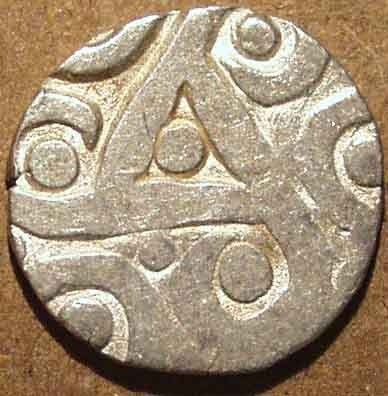
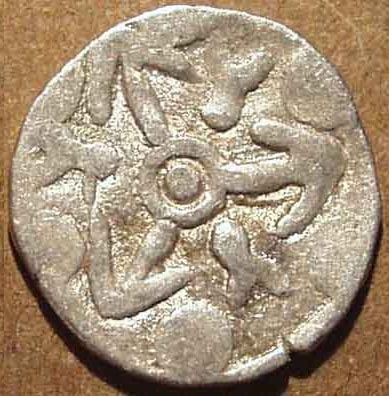
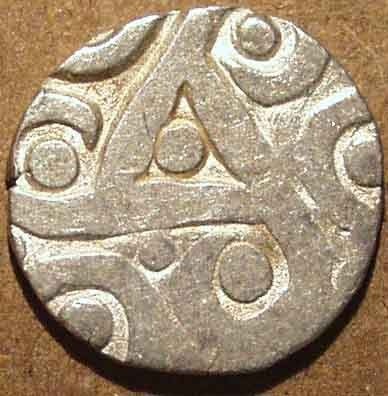
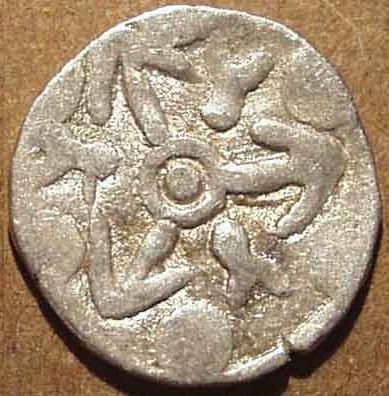
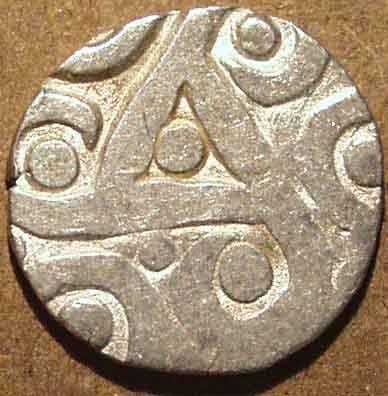
Mauryan imperial punch-marked silver coins are characterized by groups of recurring motifs, often including the sun, six-armed symbol, hill, animal, and tree forms.
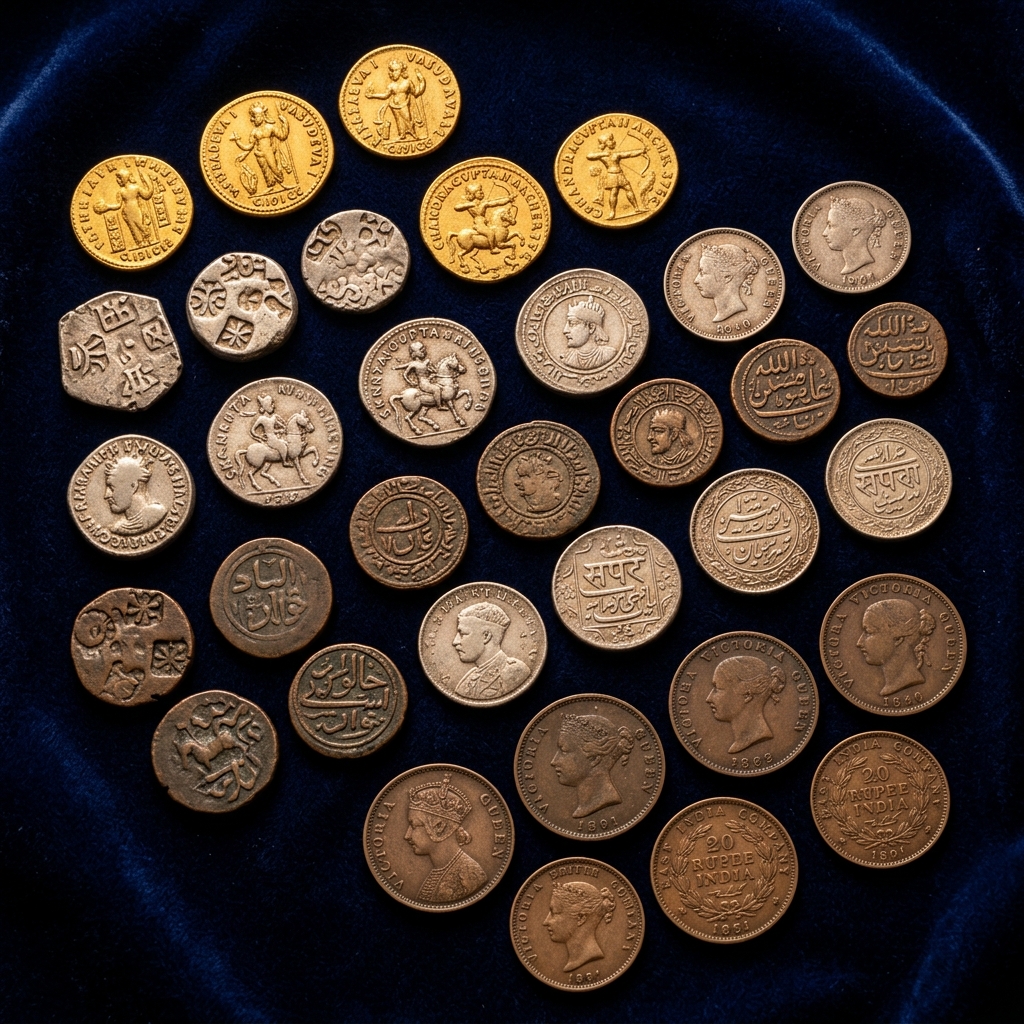
Gupta gold coins displayed the emperor engaged in imperial activities: archer, battle-axe, lion-slayer, lyrist, and ashvamedha.
Kushan gold staters blended Bactrian, Zoroastrian, Greek, and Hindu iconography (such as Shiva/Oesho and the Buddha).
Satavahana lead and potin coins provide critical chronological evidence for Deccan dynastic history.
Explore Key Coin Types
India’s oldest karshapanas with stamped symbols
Bilingual drachms featuring Hellenistic portraiture
Multicultural Silk Road gold depicting diverse deities
High-relief gold coins depicting Samudragupta & Chandragupta II
Deccan maritime ship coins and dynastic portraits
Dated profile drachms with Brahmi genealogies
Chronological Coinage Timeline
Early Exchange & Weight Standards
c. 1000 – 600 BCEUncoined metal, Ratti seed weight standards, Nishka ornaments, and measured silver bars prior to stamped currency.
Punch-Marked Karshapanas (Janapadas & Mauryas)
c. 600 – 185 BCEIndia’s earliest silver money. Cut metal blanks repeatedly stamped with symbols (sun, six-arm, hill, animal, tree).
Indo-Greek Kingdoms
c. 200 BCE – 10 CEHellenistic die-striking introduced realistic royal portraiture, Greek titles, and bilingual Greek/Kharoshthi legends.
Indo-Scythians & Indo-Parthians
c. 100 BCE – 100 CEMounted king motifs, Kharoshthi legends, speared rulers, and syncretic Greek, Iranian, and Indian deity types.
Western Kshatrapas (Sakas)
c. 35 – 405 CEDated silver drachms bearing profile portraits, Saka era regnal dates, chaitya hills, and Brahmi genealogical legends.
Satavahana Dynasty
c. 1st C. BCE – 220 CEDistinctive lead, potin, and copper issues featuring maritime ships, elephants, Ujjain symbols, and Prakrit legends.
Kushan Empire
c. 30 – 375 CEImperial Silk Road gold staters featuring royal altar sacrifices and a cosmopolitan pantheon (Buddha, Oesho, Nana, Mithra).
Gupta Empire (Golden Age)
c. 320 – 550 CEHigh-relief gold Dinars depicting Samudragupta and Chandragupta II as archers, lyrists, and horsemen with Sanskrit legends.
Post-Gupta & Early Medieval Transition
c. 550 – 750 CEStylized continuations of Gupta archer forms by Alchon Hunas, Vardhanas, Maukharis, and regional Deccan/Bengal states.
Introduction: The Birth of Indian Currency
Ancient Indian coinage is one of the clearest surviving records of the subcontinent's political, economic and cultural development. Before written chronicles became widespread, coins preserved the names of rulers and communities, dynastic claims, religious ideas, scripts, languages, trade relationships and artistic traditions. India's earliest securely documented coins are generally identified with the silver punch-marked issues that began circulating around the seventh or sixth century BCE and continued in various forms into the early centuries CE.
Over time, irregular silver pieces bearing separately punched symbols developed into gold, silver, copper, lead, potin and coins with portraits, deities, titles and multilingual legends. These objects enabled taxation and trade, proclaimed authority and communicated identity. Every surviving specimen is therefore both money and a miniature historical document.
Before Coins: Exchange in Early India
Before metallic coinage became common, communities probably relied upon barter and commodities with recognized value, including agricultural produce, cattle, metal objects and measured precious metal. Early texts use terms such as nishka, satamana, hiranya, pana and karshapana. Their meanings changed over time: some first described ornaments, metal weights or units of account and later became associated with money or coins.
Indus Valley sites have yielded seals, standardized weights and metal pieces, but scholars do not agree that these were true coins. The beginning of securely identifiable Indian coinage is therefore normally placed with punch-marked money of the early historic period, when urbanisation, organized states, agriculture and long-distance commerce were expanding.
Punch-Marked Coins: Form, Manufacture and Symbols
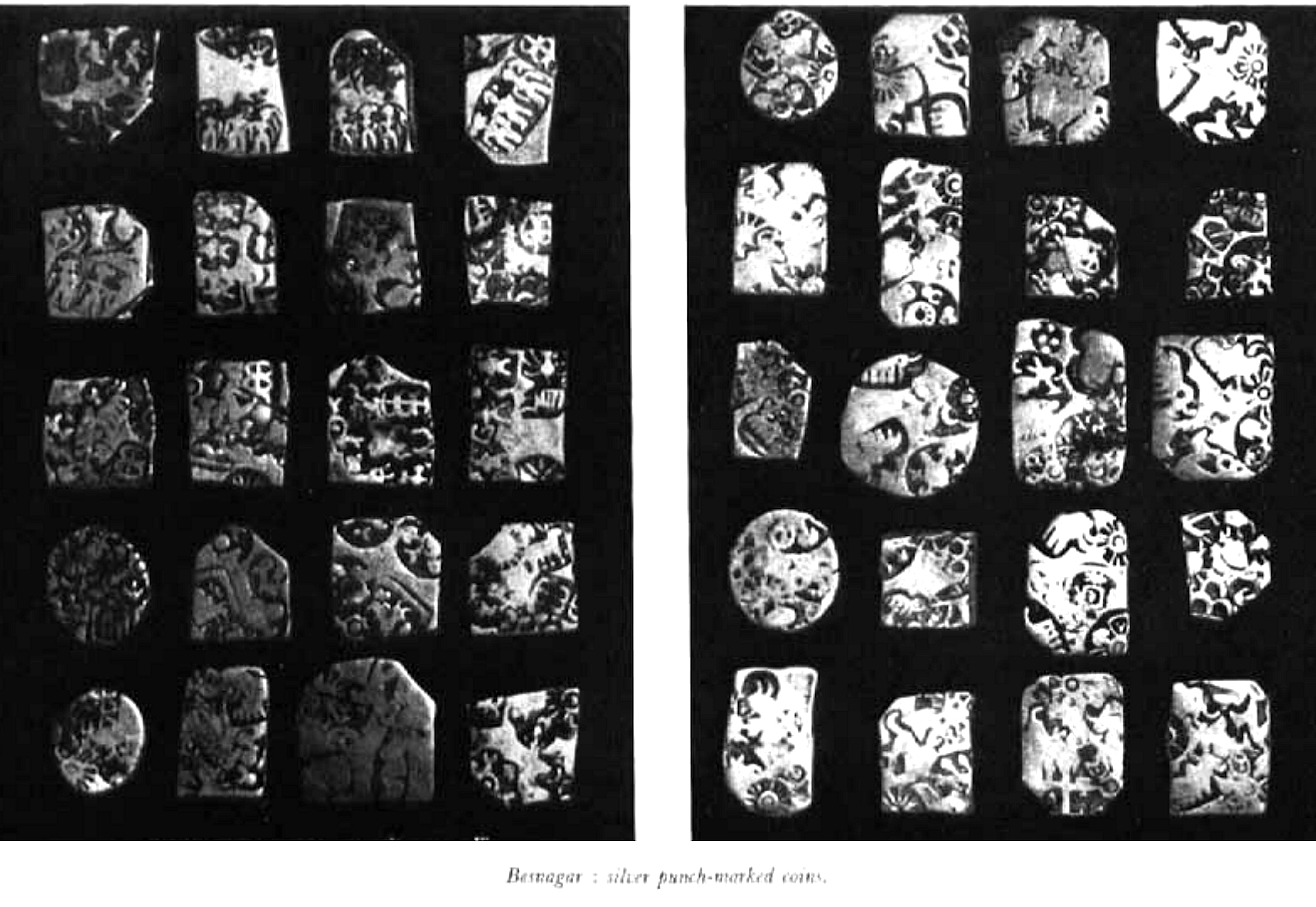
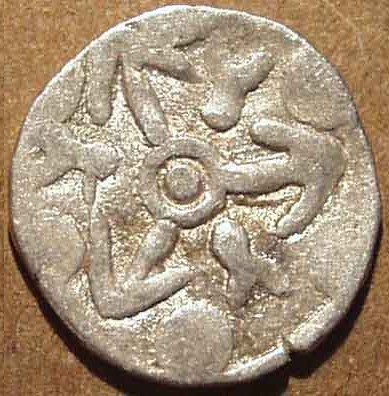
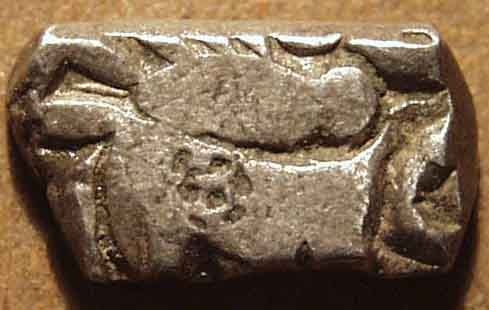
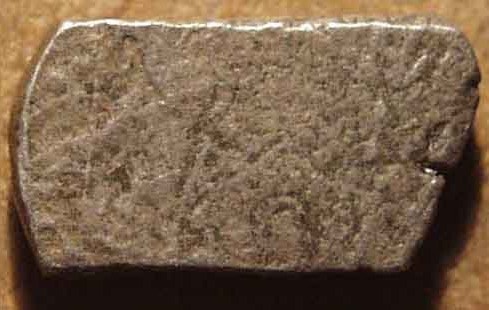
Punch-marked coins, often called karshapanas or panas, are India's earliest well-documented coinage. Instead of receiving a complete design from paired dies, a metal blank was marked repeatedly with individual punches. Silver was most common, though copper examples also circulated. Blanks were cut from sheets or bars, weighed and sometimes clipped at the edges to reach an accepted standard. They may be square, rectangular, oval, roughly circular or irregular; consistent metallic weight mattered more than perfect roundness.
Their symbols include suns, six-armed devices, trees within railings, hills, elephants, bulls, lions, fish, wheels, crescents, swastikas, wavy lines, human-like figures and composite animals. The meanings remain debated. They may indicate states, cities, administrators, guilds, religious traditions, money changers or stages of official verification. Attribution depends on the combination, style and placement of punches rather than a written ruler's name.
Janapadas, Mahajanapadas and Mauryan Currency
Between about the sixth and fourth centuries BCE, territorial states such as Magadha, Kosala, Kashi, Avanti, Gandhara, Kuru, Panchala, Vatsa, Surasena, Matsya and Asmaka issued distinct regional series. Weight, fabric and symbol arrangements help associate otherwise anonymous pieces with particular traditions. Gandharan coins, for example, often have a bent-bar form, while Magadhan issues became especially influential as the kingdom expanded.
The Mauryan Empire brought a broad territory under centralized administration from the late fourth to second centuries BCE. Many Mauryan imperial silver karshapanas are characterized by groups of recurring symbols, often including motifs such as the sun, six-armed symbol, hill, animal and tree forms. They supported revenue collection, payments to officials and soldiers, agriculture, urban markets, raw-material purchases and long-distance trade. Small secondary banker, shroff or countermarks may record testing, revalidation or acceptance by money changers; numerous marks can therefore indicate a long commercial life rather than simple damage.
Cast Copper Coinage
Alongside silver punch-marked money, ancient India produced large quantities of cast copper for lower-value local exchange. Molten copper was poured into moulds that could create several linked pieces in a casting tree; individual coins were separated after cooling. Elephants, bulls, trees, swastikas, hills, wheels, rivers and Ujjain symbols occur frequently.
Regional manufacture and the absence of full legends often make attribution difficult. Fabric, weight, metal composition, symbols, archaeological context and documented find location should be assessed together. Casting is historically normal for many ancient copper series, so the presence of cast manufacture alone must not be confused with evidence of a modern forgery.
Tribal, Civic and Regional Coinage
After Mauryan authority weakened, tribal confederacies, republics, cities and regional dynasties increasingly issued their own money. Yaudheyas, Malavas, Kunindas, Audumbaras, Arjunayanas, Vrishnis, Nagas, Mitras and Panchalas are among the groups represented. Their coins preserve the names and identities of political communities that may receive only brief attention in literary sources.
Yaudheya issues frequently depict Karttikeya or Skanda with a spear or peacock, and some legends proclaim victory of the Yaudheya people rather than an individual king. Kuninda coins from the Himalayan foothills often show a deer, a female deity commonly identified as Lakshmi, a tree, hill or river and bilingual or multi-script elements. Civic coins demonstrate that monetary authority could also belong to cities, guilds or local administrations.
Indo-Greek Portraits and Bilingual Designs
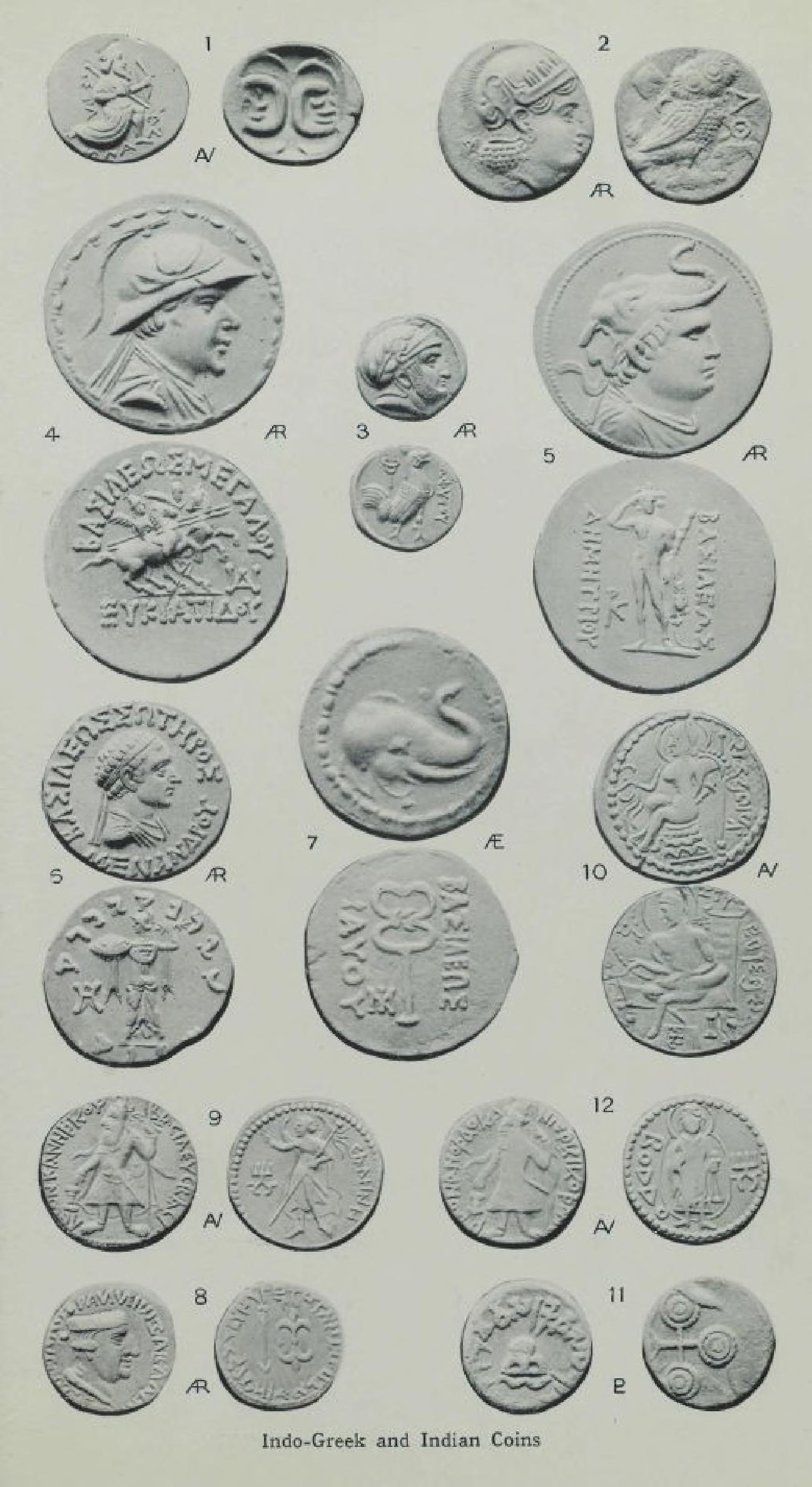
Indo-Greek kingdoms established in north-western India from about the second century BCE introduced realistic royal portraiture, engraved striking, Greek deities, regular circular flans, royal titles and bilingual legends. A ruler's portrait and Greek inscription could appear on one side, with an Indian-language translation in or on the other.
These coins record rulers whose reigns are poorly documented elsewhere and sometimes show changes in age, headgear or military equipment. Menander I, remembered as Milinda, is especially famous; other important names include Apollodotus, Antimachus, Agathocles, Eucratides, Antialcidas, Strato and Hippostratos. Their bilingual legends contributed significantly to the modern decipherment and study of ancient scripts.
Indo-Scythians, Indo-Parthians and Western Kshatrapas
Indo-Scythian or Saka rulers adopted Indo-Greek portrait conventions and bilingual legends while adding mounted kings, spear-bearing rulers, Greek-style deities such as Zeus or Nike, inscriptions and titles including Great King or King of Kings. Indo-Parthian issues similarly combine Iranian, Greek and Indian features; the coins of Gondophares are vital evidence for an important north-western ruler.
The Western Kshatrapas governed much of Gujarat, Malwa and adjoining regions from about the first to fourth centuries CE. Their silver coins typically show a profile bust, a stylized Greek border , a three-arched hill or , crescent and star, and a naming the ruler and genealogy. Many are dated in a regional era, creating an unusually useful chronological sequence.
Satavahana Coinage and Maritime Imagery
The Satavahanas ruled extensive areas of the Deccan and issued an exceptionally varied coinage in lead, copper, potin, silver and other alloys. Their extensive use of lead is a distinctive feature of ancient Indian monetary history. Designs include elephants, lions, horses, ships, chaityas, trees, wheels, Ujjain symbols, portraits and legends.
Ship types are often associated with maritime activity along India's western and eastern coasts. Some Satavahana rulers also issued silver portrait pieces influenced by Western Kshatrapa designs, demonstrating both rivalry and artistic borrowing between neighbouring powers.
Kushan Gold and a Multicultural Pantheon
The Kushan Empire connected northern India with Afghanistan, Central Asia and major branches of the Silk Road. Its substantial gold and copper currency is among the ancient world's most cosmopolitan. Rulers may appear sacrificing at an altar or holding weapons and royal objects, dressed in heavy boots, long coats and tall crowns with flame-like shoulder ornaments. Such imagery proclaimed military power and sacred kingship.
types name and depict deities drawn from Greek, Iranian, Buddhist and Indian traditions, including Helios, Selene, Nana, Mithra, Mao, Oesho, Buddha, Maitreya, Ardoksho and Athsho. Kanishka's gold issues include some of the earliest securely identified images of the Buddha on coins. This diversity reflects an empire positioned between India, Iran, Central Asia and the Mediterranean world.
Ancient South India and Roman Trade
Ancient southern India developed distinctive regional monetary systems linked to the Cheras, Cholas, Pandyas and local authorities of the Deccan and Tamil regions. Dynastic emblems enabled recognition even without readable inscriptions: the Chera bow and arrow, Chola tiger and Pandya fish are especially important. Elephants, ships, trees, hills and geometric symbols also occur.
Large quantities of Roman gold and silver have been found in southern and western India, documenting trade in pepper, spices, textiles, gemstones, ivory, pearls and aromatic products. Roman pieces may have served as bullion, prestige objects, ornaments or high-value money. Piercing, cutting and local imitation show how their function changed after entering Indian economic and cultural settings.
Gupta Gold: Art, Kingship and Religion
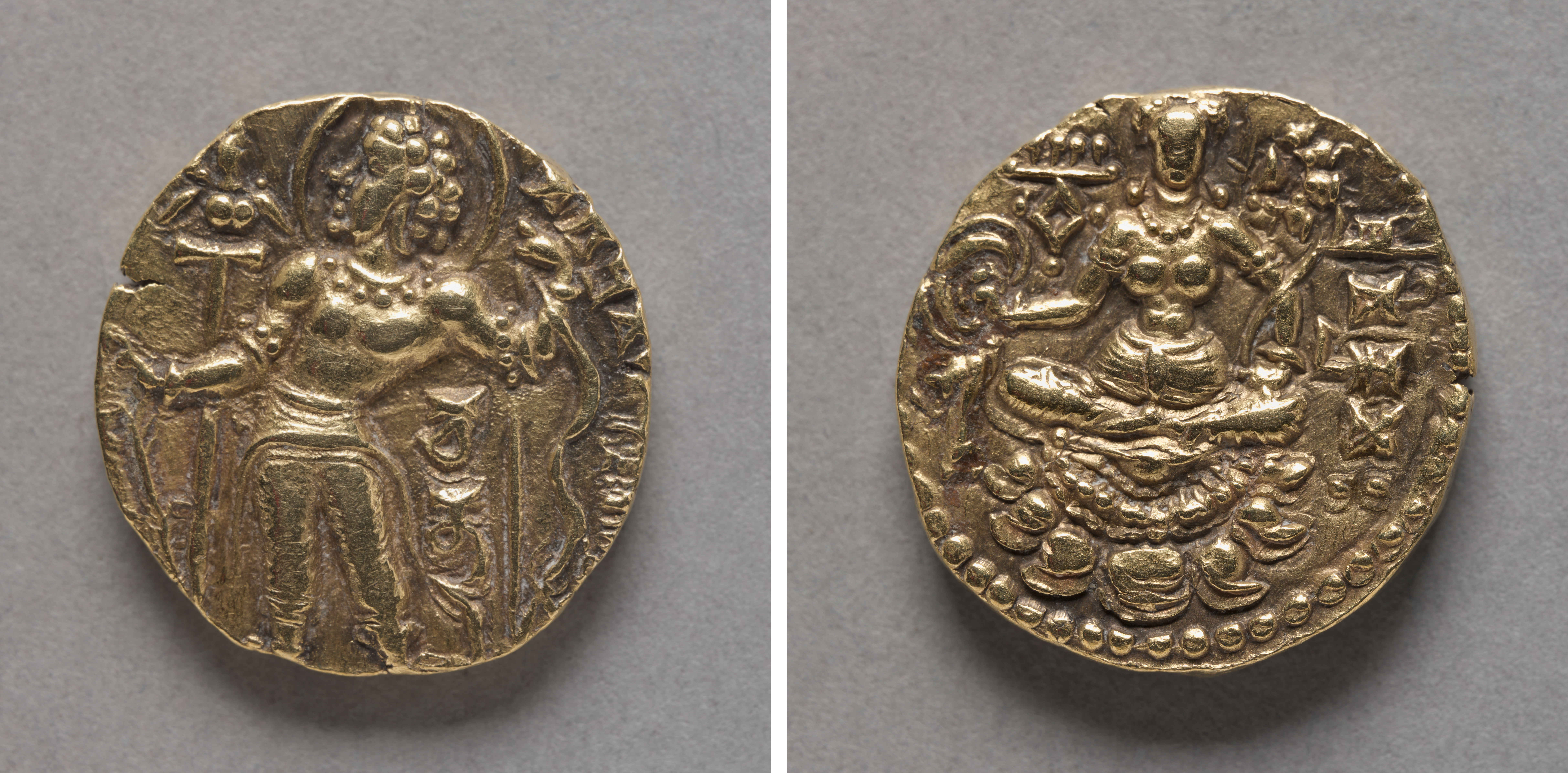
The Gupta dynasty, dominant across much of northern India from about the fourth to sixth centuries CE, produced some of India's most celebrated gold coins. Fine engraving, dynamic royal images, Sanskrit legends, religious themes and numerous commemorative types combine artistic quality with imperial messaging.
Samudragupta appears standing beside an altar, holding a bow, carrying a battle axe, playing a veena in the remarkable Lyrist type, or associated with the Ashvamedha horse sacrifice. Chandragupta II continued the archer tradition and introduced types such as lion-slayer and horseman. Reverses commonly show Lakshmi or other goddesses, while Garuda became a powerful dynastic emblem. Sanskrit legends in script praise royal virtue, conquest and divine favour.
Post-Gupta and Late Ancient Traditions
After Gupta power declined, Later Guptas, Alchon or Huna rulers, Vardhanas, Maukharis, Maitrakas, early Rajput dynasties and regional kingdoms in Bengal, Kashmir and central India produced transitional coinages. Many copied respected Gupta forms, especially the archer type, but gradually rendered them in more stylized ways.
The survival and transformation of an older design show that trusted monetary imagery could outlast the dynasty that created it. These issues form an important bridge between the classical ancient traditions and the increasingly regional systems of early medieval India.
Metals and Monetary Roles
Gold supported royal gifts, military payments, high-value exchange and displays of prestige. Kushans and Guptas were leading gold issuers, joined by some Indo-Greek and southern powers. Silver formed the foundation of punch-marked currency and remained important under Indo-Greeks, Western Kshatrapas and regional states.
Copper enabled everyday local exchange and was struck or cast across the subcontinent. Lead is especially associated with Deccan and Satavahana traditions, while potin and allowed authorities to adjust supply and value through mixed-metal alloys. Metal must always be considered with weight, region, design and historical standard rather than treated as of attribution by itself.
Scripts, Languages and Religious Symbolism
Ancient coins use Greek, Prakrit, Sanskrit and regional languages written in Greek, , and later derivatives. Bilingual legends document cultural contact and help identify rulers, titles and territories. Letter forms can also support dating, though worn or partial legends require cautious reading.
Religious imagery ranges from Hindu deities and emblems such as Lakshmi, Shiva-associated Oesho, Karttikeya, Garuda, bulls and ritual symbols to Buddhist stupas, trees, wheels, Buddha and Maitreya. Jain traditions appear in relevant regional contexts, while Indo-Greek, Saka, Parthian and Kushan coins preserve Greek and Iranian gods. These images served devotion, legitimacy and imperial communication simultaneously.
How Ancient Indian Coins Were Made
Ancient Indian mints used several techniques. Punch-marking applied separate symbols one at a time to a prepared blank. Casting poured molten metal into moulds, sometimes producing connected groups later separated. striking placed a blank between engraved and dies and transferred the design with force. Repoussé and related methods appear in particular regional or specialized traditions.
Hand production naturally created differences in centring, alignment, , thickness and strength. These variations are not automatically defects or signs of forgery. The correct manufacturing fabric should instead be compared with well-attributed examples of the same series.
Coins as Instruments of Sovereignty
Issuing coinage made political authority visible. A symbol, portrait, royal title, deity or community could proclaim the right to collect taxes, regulate trade and command territory. Successor rulers sometimes retained familiar types to inherit their commercial trust, while others overstruck older coins to announce conquest or monetary reform.
An is made by placing a new design over an existing coin rather than melting it. Surviving traces can reveal chronological relationships, reused foreign money, metal shortages or rapid political change. For numismatists, an identifiable undertype can be direct evidence that one authority followed another.
Economy and Ancient Trade Networks
Coinage supported taxes, soldiers and officials, agricultural markets, craft production, urban exchange and long-distance commerce. Finds link India with Central Asia, Iran, the Roman and Mediterranean world, Sri Lanka and Southeast Asia. Silk Road routes carried Kushan money and ideas across inland networks, while coastal trade moved bullion and commodities through western and southern ports.
Distribution patterns, hoards and imported coins help reconstruct the movement of goods and metal. A coin's economic meaning depended on its accepted weight, purity and issuing authority, but foreign pieces could also be valued as bullion or adapted for local use.
How Coins Help Reconstruct History
Coins can identify rulers absent from surviving chronicles, clarify genealogies, preserve scripts, record titles and reveal religious or political change. Portrait sequences, links, metal analysis and overstrikes can establish relative chronology. Minting volume and geographic distribution offer evidence about administration and commerce.
Ancient coin hoards are especially valuable when scientifically excavated. People concealed savings, commercial stores or offerings during war, instability, migration or fear of theft. The coins' arrangement and archaeological layer may show which issues circulated together and when they were buried. Undocumented dispersal destroys much of this evidence.
Obverse, Reverse and Dating
On a die-struck coin, the generally carries the principal authority—a portrait, ruler, dominant deity or royal title—while the holds a secondary deity, symbol, mark, monogram, or supporting design. The distinction can be uncertain for punch-marked coins because their symbols were applied separately and may not form a conventional paired design.
Dating relies on written eras, known rulers, genealogy, archaeological layers, hoards, overstrikes, style, metallurgy and die-link studies. Not every attribution is secure, and new finds can change accepted chronologies. Responsible cataloguing distinguishes confirmed, probable and uncertain dates rather than presenting every estimate as fact.
Identifying Ancient Indian Coins
Identification should record metal, weight, diameter, thickness, , , portrait, symbols, script, language, borders, fabric, manufacture and documented find location. Clear photographs of both sides are essential. Several features must be compared together: an elephant, for example, appears on coins of many dynasties and cannot identify an issuer without the , metal, weight and style.
Begin with the broad manufacturing and regional tradition, then narrow the ruler, and type through recognized catalogues, museum collections and specialist references. Partial legends and off-centre strikes require comparison with complete specimens rather than guesswork.
Collector Workflow: 8 Steps to Identify an Ancient Indian Coin
Determine if the specimen is silver, gold, copper, lead, potin, or billon. Observe if the blank was cut, cast, or die-struck.
Weigh in grams to 0.01g precision. Compare against ancient weight standards (e.g. Karshapana ~3.4g, Dinar 7.8g–9.2g, Drachm ~2.4g).
Note whether the flan is square, irregular punch-cut, or circular die-struck. Measure maximum and minimum diameter.
Examine primary imagery: royal bust, king standing, bow & arrow, altar sacrifice, elephant, horse, ship, or punched symbols.
Check for Greek, Kharoshthi (right-to-left), or Brahmi (left-to-right) letter forms and titles (e.g. Rajan, Maharaja, Basileos).
Match combined ruler features, deity iconography, and epigraphy to known imperial or regional series.
Consult specialized catalogues (Allan, Rapson, Gupta, Bhandarkar) to pinpoint exact variety, mint mark, or regnal year.
Compare die characteristics with published museum reference collections (British Museum, ASI, IIRNS).
Authenticity and Forgeries
Ancient Indian coins are copied, altered and falsely attributed. Warning signs include modern casting seams, repeated identical flans, artificial smoothness, false , incorrect metal, modern tool marks, unnaturally sharp detail or historically impossible and combinations. Genuine pieces, however, may be porous, irregular, weakly struck or off-centre, so no single symptom is decisive.
Authentication should combine accurate measurements, magnification, comparison with established catalogues, die-study evidence, metallurgical testing when appropriate, specialist review and verified . Expensive or exceptional rarities deserve especially careful independent examination.
- Verify exact weight (0.01g) against published catalogue weight standards for the specific series.
- Inspect flan edge for modern casting seams, filing marks, or split molds.
- Examine surface fabric for artificial pitting, acid etching, or glued fake patinas.
- Check strike characteristics—die-struck coins display radial metal flow lines under magnification.
- Consult published die studies and verified museum references (British Museum, ASI, IIRNS).
Collecting and Factors Affecting Value
Because the field is vast, new collectors benefit from focusing on a theme such as punch-marked coins, Mauryan issues, tribal republics, Indo-Greek rulers, Western Kshatrapas, Satavahanas, Kushans, Gupta gold, ancient southern dynasties, animals, deities, bilingual legends or a particular region. A focused collection is easier to research and authenticate than an unstructured accumulation.
Value depends on , historical importance, ruler, dynasty, metal, weight standard, portrait quality, inscription legibility, completeness, centring, surface, , and collector demand. A rare ruler with a readable name may be more significant than a visually attractive common type, while documented can add both scholarly and market value.
Preservation and Storage
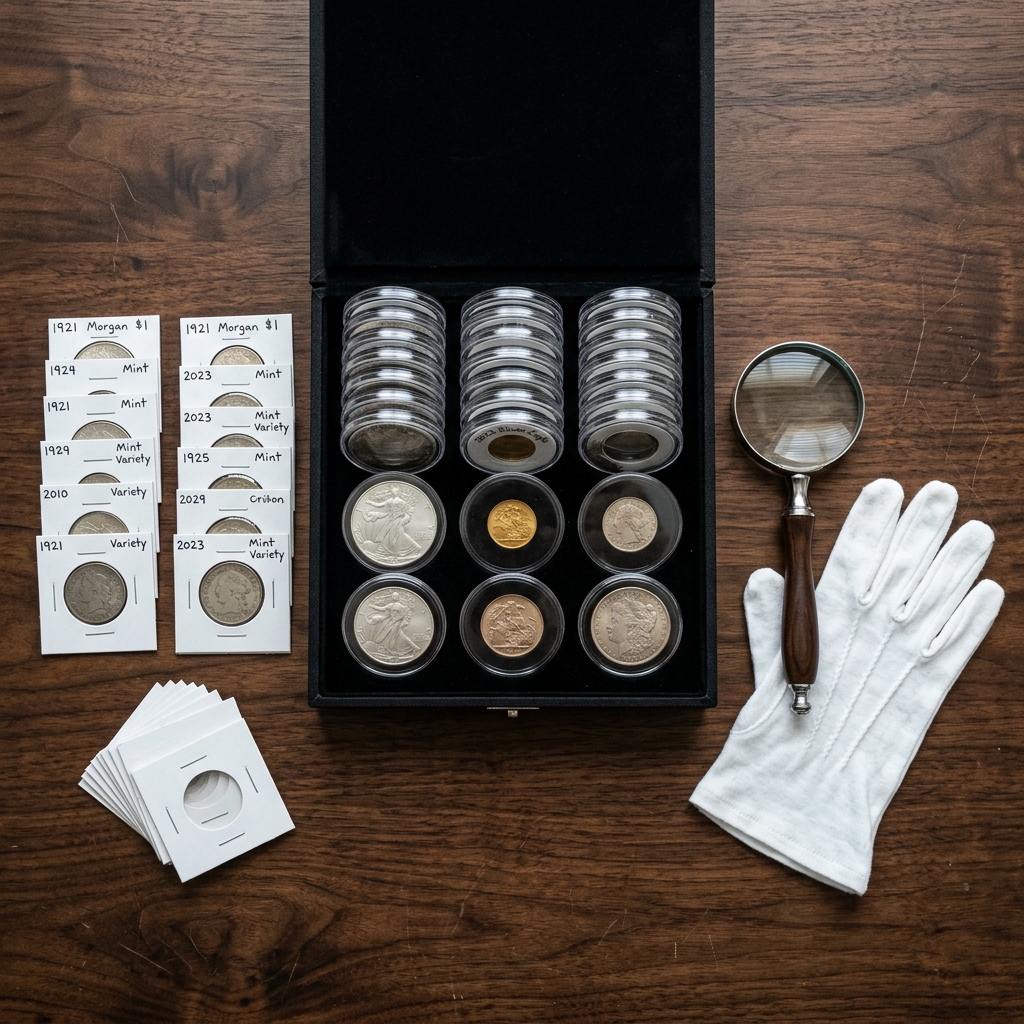
Handle coins by their edges, use inert archival holders and maintain a stable, dry environment. Record weight, dimensions and , photograph both sides and inspect copper or bronze periodically for active corrosion. Isolate any affected piece and consult a qualified conservator.
Avoid polishing, abrasive , acids, wire brushes, household chemicals, untested oils and removal of stable . can erase inscriptions, tool marks, surface structure and archaeological evidence. Natural is often desirable and may protect the metal beneath.
Legacy of Ancient Indian Coinage
Ancient Indian coinage records extraordinary political and cultural diversity: abstract punch-marked silver, Indo-Greek bilingual portraits, Satavahana maritime designs, Kushan religious pluralism and Gupta gold artistry each represent a different stage of monetary development. The coins show that India was deeply connected with Central Asia, Iran, the Mediterranean world and Southeast Asia while developing its own distinctive systems of symbolism and royal communication.
Their importance extends beyond price. They preserve forgotten kingdoms and scripts, portray rulers and deities and document the movement of people, metals, beliefs and artistic ideas. A Mauryan karshapana from an urban market, a Kushan gold coin moving along the Silk Road and a Gupta presented at court are all direct witnesses to ancient economic life and political imagination.
Frequently Asked Questions
What are the earliest documented Indian coins? Silver punch-marked coins from approximately the seventh or sixth century BCE. Why are they called punch-marked? Their symbols were applied with separate punches rather than a single pair of complete engraved dies. Which dynasties produced outstanding gold? Gupta gold is renowned for artistic , while Kushan gold is equally important for royal portraits and multicultural deities.
Which metals were used? Gold, silver, copper, lead, potin, and other alloys. Did ancient coins carry dates? Some, including many Western Kshatrapa issues, contain chronological information; others are dated through archaeology and ruler sequences. Why are early coins irregular? Blanks were manually cut, cast and weight-adjusted. Should they be cleaned? Generally no—improper can destroy , inscriptions and historical evidence.
Sources & Further Reading
- Allan, John. Catalogue of the Coins of Ancient India in the British Museum. Trustees of the British Museum, London, 1936.
- Rapson, Edward James. Catalogue of the Coins of the Andhra Dynasty, the Western Ksatrapas, the Traikutaka Dynasty and the "Bodh" Dynasty. British Museum, London, 1908.
- Gupta, Parmeshwari Lal. Coins: India - The Land and the People. National Book Trust, New Delhi, 4th ed., 2013.
- Bhandarkar, D.R. Lectures on Ancient Indian Numismatics (Carmichael Lectures). University of Calcutta, 1921.
- Cunningham, Sir Alexander. Coins of Ancient India: From the Earliest Times Down to the Seventh Century A.D. B. Quaritch, London, 1891.
- Reserve Bank of India Monetary Museum. Monetary Heritage of India: Ancient Coinage Archive. RBI Numismatic Division, Mumbai.
- Indian Institute of Research in Numismatic Studies (IIRNS). Numismatic Digest & Academic Specimen Archives. Anjaneri, Nashik.
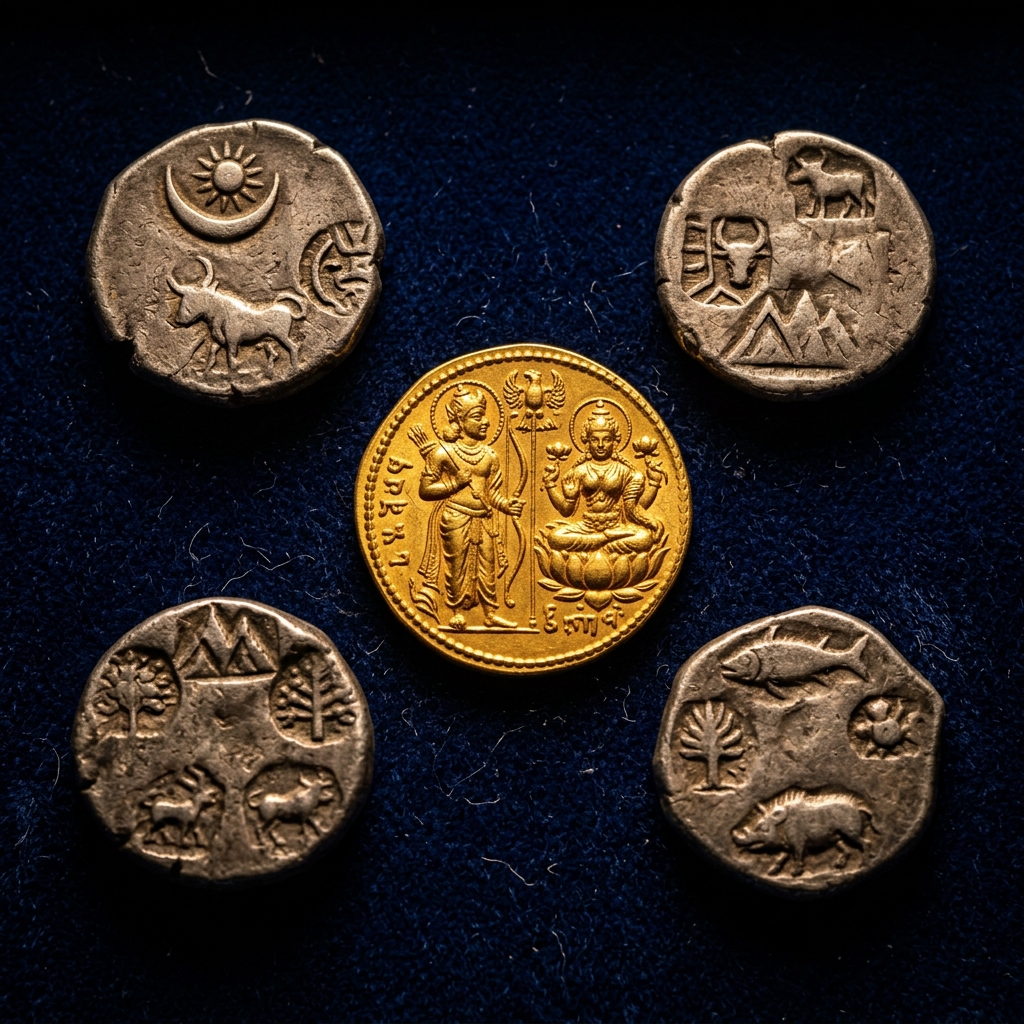
Mauryan Punch-Marked Silver vs. Gupta Imperial Gold Dinar
Observe the evolution from symbolic punch-marked metallurgy to high-relief classical imperial die-striking.
- Irregular flan shape cut from silver sheets or bars
- Multiple individual punches were applied separately to the prepared silver blank
- General absence of ruler portraits or written names
- Standard weight based on 32-ratti (~3.4 grams)
- Round flan struck between engraved upper and lower dies
- Samudragupta — Archer Type (King holding bow beside a Garuda standard)
- Sanskrit legend in Brahmi script around the perimeter
- Reverse depicting Goddess seated on a throne or lotus
Explore the details
Was this numismatic guide helpful?
Your feedback helps our curatorial editorial team refine and expand our research.