ON THIS PAGE
- Overview & Key Concepts
- What Makes an Indian Coin Valuable?
- Ancient India's Most Valuable Coins
- Medieval India's Most Valuable Coins
- Mughal India's Most Valuable Coins
- Maratha & Princely States Coinage
- British India Coins & Historic Rarities
- Republic of India Rarities & Error Coins
- The Importance of Coin Grade & Relative Value
- Essential Collector Tips for High-Value Coins
- Notable High-Value Indian Coins Reference Table
- Curated Specimen Examples
- Common Mistakes to Avoid
- Frequently Asked Questions
Key Takeaways & Executive Summary
Jahangir’s gold Zodiac Mohurs struck at Agra and Ahmedabad represent the peak of Mughal numismatic art.
The 1939 British India silver Rupee is exceptionally rare because most were melted down after silver content was reduced in 1940.
The 1970 Republic of India 1 Rupee struck at Bombay Mint is among the most sought-after modern circulation key dates.
Condition rarity means an ordinary coin in pristine MS-65+ can be worth 50x more than the same coin in VF condition.
What Makes an Indian Coin Valuable?
India's numismatic heritage spans more than 2,500 years, making it one of the richest and most diverse coin traditions in the world. From the punch-marked silver coins of ancient Mahajanapadas to the gold mohurs of the Mughal emperors, the elegant rupees of British India, and the rare error coins of the Republic era, Indian coins reflect the country's political, cultural, and economic evolution.
While millions of Indian coins survive today, only a select few are considered exceptionally valuable. Their worth is determined not only by age, but also by , historical significance, condition, demand, , and precious metal content. Some have sold for a few lakh rupees, while others have fetched several crores at international auctions.
Key Factors That Determine a Coin's Value
- 1. Rarity: Coins with very low mintages or few surviving specimens command premium prices. Some coins were issued only for a short period, while others were experimental patterns, off-metal strikes, or ceremonial presentation issues.
- 2. Historical Significance: Coins associated with major historical events, transformative treaties, or influential rulers often become highly collectible. Examples include coins of Chandragupta II, Akbar's religious Ilahi coinage, Shivaji Maharaj's coronation coins, British India trial pieces, and inaugural Republic commemorative issues.
- 3. Precious Metal: Gold and silver coins generally attract higher baseline demand, especially when they combine bullion intrinsic value with historical importance and artistic mastery.
- 4. Condition (Grade): Condition has an enormous impact on value. For example, a Mughal in Fine (F) condition may be worth ₹8,000, while the exact same coin in pristine State (MS) may sell for ₹1,00,000 or more.
- 5. Provenance: Coins from famous historic collections (such as the British Museum, Spink, or David Fore collections) or prestigious auctions often command substantial premiums because of their verified, documented ownership history.
- 6. Collector Demand: Certain rulers and series enjoy consistently strong collector demand: Gupta gold dinars, Mughal zodiac mohurs, East India Company uniform issues, rare British India key-date rupees, and dramatic Republic error coins.
Ancient India's Most Valuable Coins
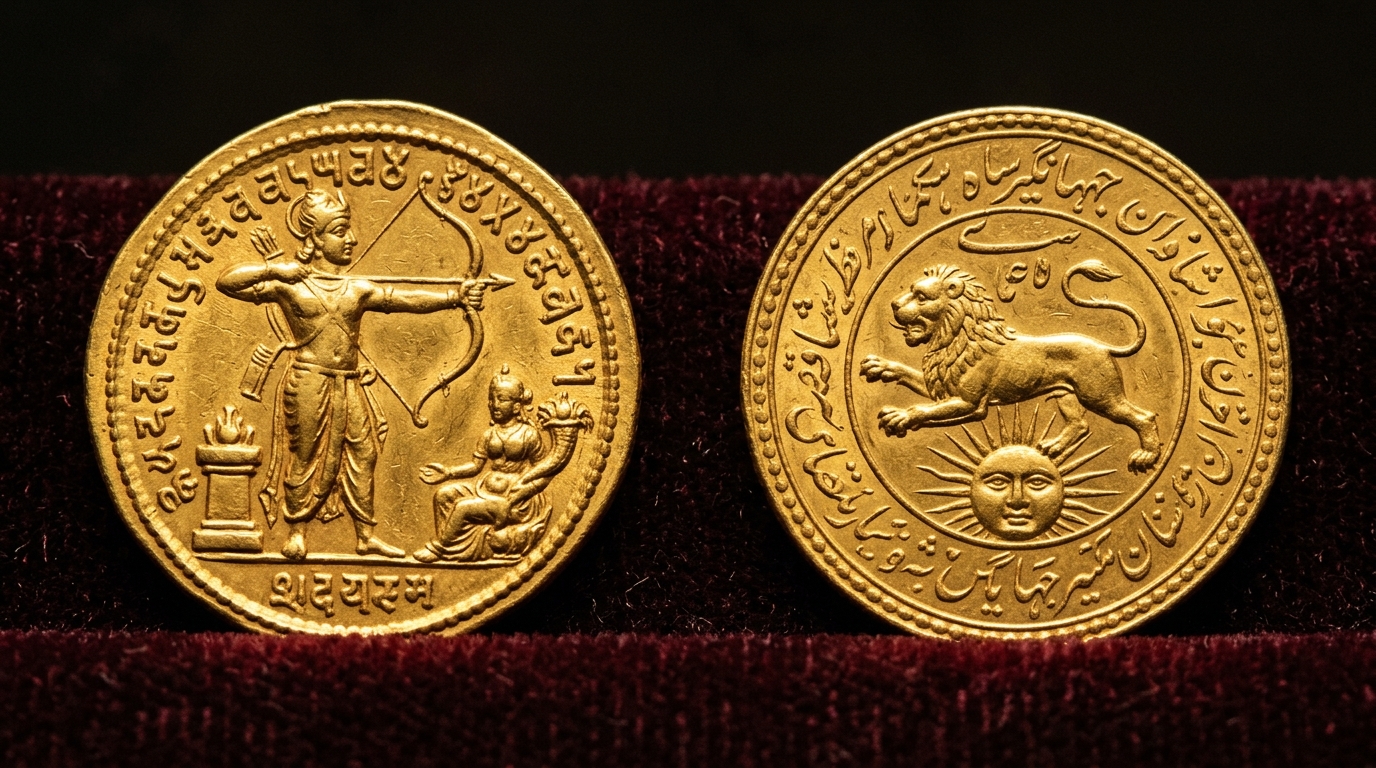
Ancient India produced some of the world's most sophisticated and artistically celebrated coinages.
Gupta Gold Dinars (4th–6th Century CE)
The Gupta Empire produced some of the finest gold coins ever minted in world history. Known as Dinars (derived from the Roman denarius), these coins are celebrated for their classical artistic beauty, intricate legends, and detailed iconography.
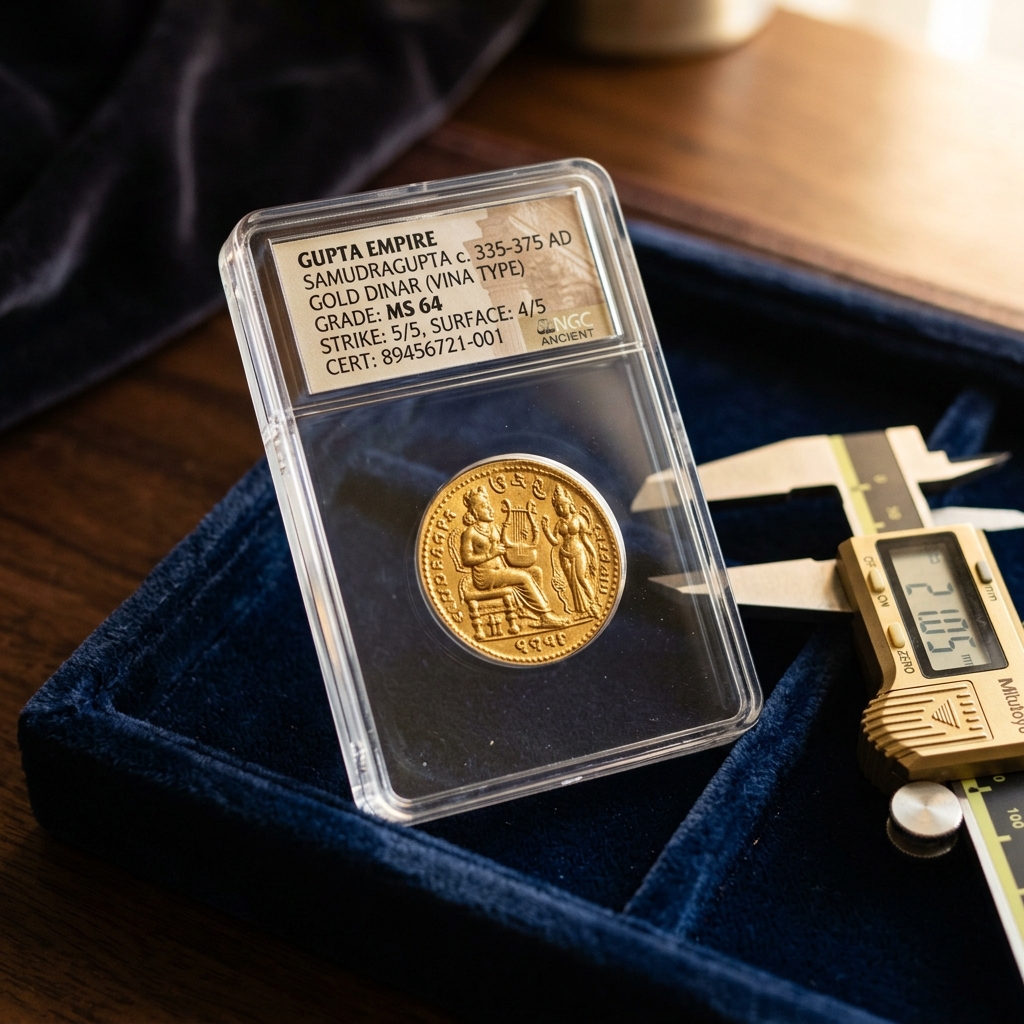
Common depictions and motifs include: - Archer Type: Depicting the king holding a longbow and arrow, symbol of martial valor and sovereign power. - Tiger Slayer & Lion Slayer Types: Portraying the emperor combating ferocious wild beasts, symbolizing royal dominance. - Horseman Type: The emperor mounted on a caparisoned steed. - Ashvamedha Sacrifice Type: Commemorating the grand Vedic imperial horse sacrifice. - Veena-Playing Samudragupta Type: Showing the emperor seated on a high-backed couch playing the musical veena, highlighting his accomplishments as a patron of the arts.
Why They Are Valuable: High-purity gold, exceptional classical Gupta artistry, profound historical importance, and a limited number of well-preserved surviving specimens. Typical Value: ₹2 lakh to over ₹1 crore. Exceptional top-grade specimens of rare types (such as the King and Queen type or Lyrist type) may exceed ₹2 crore.
Punch-Marked Coins (c. 6th–2nd Century BCE)
India's earliest coins date to around the 6th century BCE during the Vedic Mahajanapada era. Struck on silver planchets with individual punches, they bear symbols representing nature, astronomy, royal emblems, and geometry.
Valuable Examples: - Magadha Imperial issues with distinctive 5-symbol configurations. - Gandhara bent bar Shatamanas (heavy silver bent bars with six-armed solar symbols). - Rare Mahajanapada varieties (Kuru, Panchala, Surasena, and Kuntala Janapadas). - Unpublished symbols and heavy denomination rarities.
Typical Value: ₹20,000 to ₹10 lakh+ depending on , completeness of symbols, and hoard .
Medieval India's Most Valuable Coins
The medieval period witnessed dramatic innovations in metallurgy, weight standardization, and calligraphic design across northern and southern India.
Sher Shah Suri Silver Rupees (1540–1545 CE)
Sher Shah Suri introduced the standardized Rupiya (a pure silver coin weighing approximately 178 grains / 11.5 grams) that later became the direct monetary ancestor of India's modern currency system. - Rare varieties (such as Shergarh, Ujjain, and Chunar) and exceptional State specimens with crisp Arabic/Persian legends and Devanagari ruler names are highly sought after by advanced collectors. - Typical Value: ₹50,000 to ₹15 lakh.
Vijayanagara Gold Pagodas (Varahas)
Known as "Varahas" or Pagodas, these small but beautifully struck gold coins are among South India's greatest numismatic treasures. - Depicting Hindu deities such as Shiva-Parvati, Lakshmi-Narayana, Venkateshwara, and the mythical double-headed eagle Gandaberunda. - Popular rulers include Krishnadevaraya and Achyuta Deva Raya. - Typical Value: ₹1 lakh to ₹50 lakh+.
Chola Gold Coins (9th–13th Century CE)
Rare gold coins of the imperial Chola Empire are exceptionally scarce because relatively few gold hoards have survived. - Important rulers include Rajaraja I (with the seated king and standing king motifs) and Rajendra I (featuring the Chola tiger flanked by the Pandyan twin fishes and Chera bow). - Typical Value: ₹2 lakh to ₹30 lakh+.
Mughal India's Most Valuable Coins
The Mughal Empire produced some of the finest, most artistically ambitious coins in world history, combining high-purity precious metals with poetic Persian calligraphy and astronomical motifs.
Akbar Gold Mohurs (1556–1605 CE)
Emperor Akbar introduced numerous innovative coin designs reflecting his religious and philosophical reforms: - Ilahi Series: Dated according to his Divine Era (Tarikh-i-Ilahi), featuring Persian month names. - Square Mohurs & Rupees: Struck at mints like Urdu Zafar Qarin, Agra, and Lahore. - Sacred Inscriptions: Featuring his universal spiritual motto Allahu Akbar Jalla Jalaluhu. - Typical Value: ₹10 lakh to several crores for gold mohurs and rare celebratory issues.
Jahangir Zodiac Mohurs & Rupees (1605–1627 CE)
Jahangir's Zodiac series represents the absolute pinnacle of Mughal numismatic artistry and is celebrated internationally: - Instead of traditional textual calligraphy alone, each coin depicts one of the twelve astrological zodiac signs (Leo, Scorpio, Taurus, Gemini, Cancer, Libra, Sagittarius, etc.) framed by radiating solar rays. - Struck in both Gold (Mohur) and Silver () primarily at Agra and Ahmedabad. - Why They Are Exceptionally Rare: When Emperor Shah Jahan ascended the throne, he ordered all circulating Zodiac coins to be surrendered and melted into standard bullion. Surviving genuine examples are vanishingly rare. - Auction Records: Outstanding specimens have sold at international auctions in London, Zurich, and New York for multiple millions of dollars (exceeding ₹5 to ₹10+ crore).
Shah Jahan Presentation Mohurs (1628–1658 CE)
Gigantic presentation coins and commemorative mohurs struck for imperial nobles and foreign ambassadors are among the rarest and heaviest gold coins ever struck in Asia. - Typical Value: ₹20 lakh to ₹5 crore+.
Maratha & Princely States Coinage
Regional kingdoms across India created coins of immense historical and numismatic significance.
Shivaji Maharaj Gold Hon
Coins issued during the reign of Chhatrapati Shivaji Maharaj (1674–1680 CE) are of paramount national and historical importance: - Original gold Hons bear the Nagari legends 'Shri Raja Shiva' on the and 'Chhatrapati' on the . - Genuine contemporary gold Hons are extremely rare, with many later imitations existing in the market. - Typical Value: ₹3 lakh to ₹50 lakh+.
Coronation Coins (Rajyabhishek Hon)
Special gold and silver coins struck on the auspicious occasion of Shivaji Maharaj's coronation (Rajyabhishek) at Raigad in 1674 are among the most revered Maratha coins. - Exceptional verified examples have sold for well over ₹1 crore.
Princely States Coinage
Hundreds of autonomous Princely States minted their own coinage under treaty with the British Crown: - Highly sought-after states include Hyderabad (Charminar silver rupees and gold ashrafis), Jaipur (gold mohurs), Baroda (Sayajirao III portrait rupees), Travancore (gold fanams and silver chuckrams), Mysore (Krishna Raja Wadiyar gold pagodas), Kashmir, Kutch (silver koris with Khengarji III titles), and Indore. - Rare gold presentation and commemorative nazarana issues frequently achieve ₹10 lakh to ₹1 crore+.
British India Coins & Historic Rarities
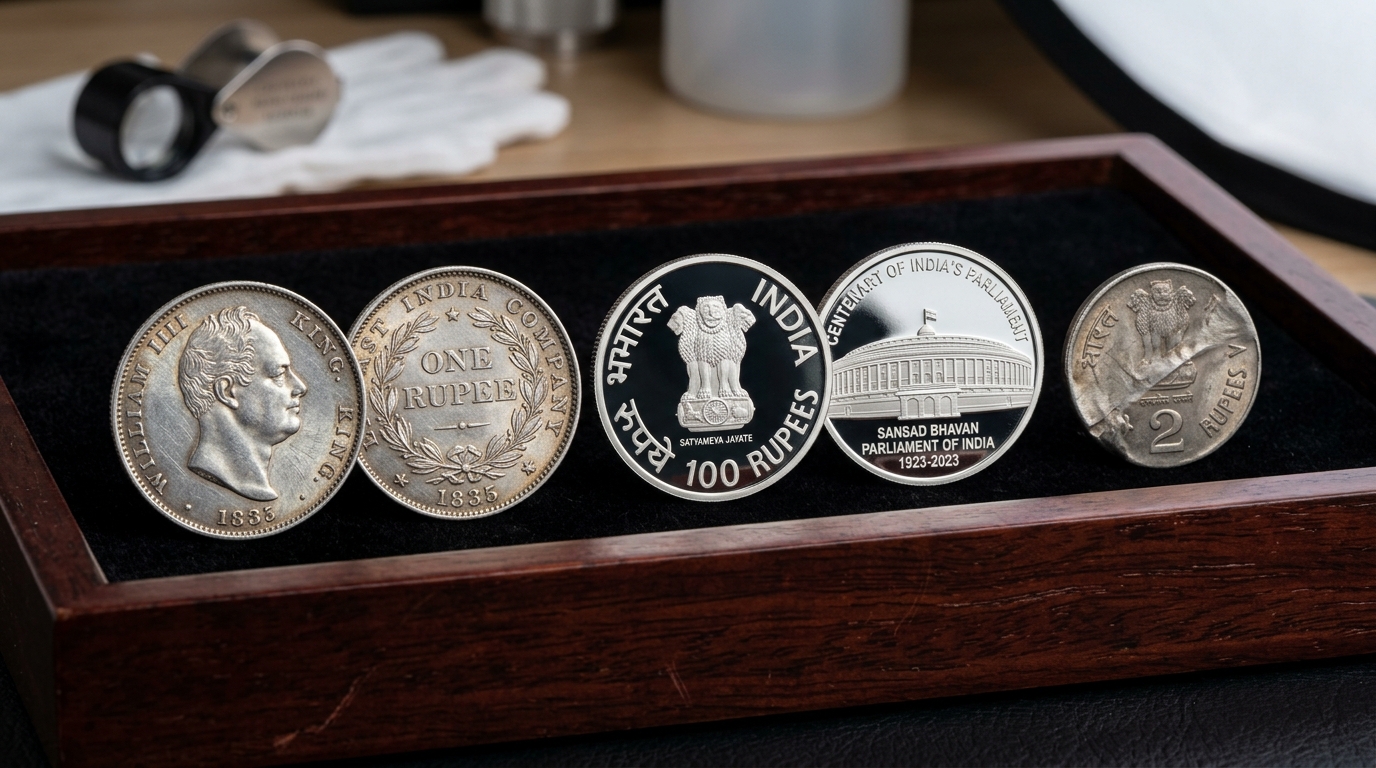
British India coins (1835–1947) represent one of the most widely collected segments of world numismatics.
1835 Rupees (King William IV)
coins were experimental trial designs struck in tiny quantities to test new dies, portrait alignments, and millings before mass production. - Because only a handful of genuine original 1835 rupees survive, they are considered ultra-rarities. - Typical Value: ₹20 lakh to ₹2 crore+.
1862 Queen Victoria Rupees & Varieties
The 1862 issue marked the first regular coinage struck under direct British Crown rule following the 1857 uprising: - The series contains dozens of complex varieties, dot and crescent marks (attributed to Bombay and Calcutta mints), and proofs. - Superb Gem State and examples command massive premiums over regular circulated coins.
1911 King George V "Pig "
The initial 1911 design depicted King George V wearing the collar of the Most Eminent Order of the Indian Empire: - The small elephant on the collar was engraved with short legs and prominent ears, leading to a public controversy that it resembled a pig. - The design was promptly withdrawn and modified for 1912, making high-grade 1911 rupees and strikes highly sought after.
1939 Silver Rupees & Sets
In 1939, as World War II began, the silver content of the Indian was about to be reduced from 91.7% to 50% quaternary alloy: - The vast majority of 1939 .917 fine silver rupees were melted down before leaving the . Surviving genuine 1939 rupees are rare and valuable. - Typical Value: ₹5 lakh to ₹50 lakh+ for high-grade specimens and original sets.
British India Error Coins
Historic minting errors from the colonial era are scarce: - Major off-center strikes, dramatic brockages (incuse impressions), double strikes, and wrong errors routinely realize several lakhs at specialized auctions.
Republic of India Rarities & Error Coins
While most modern circulating Indian coins are common, select dates, sets, and striking errors are exceptionally valuable.
1950 Coins & Inaugural Republic Issues
Following the adoption of the Constitution of India on 26 January 1950, India's mints produced the nation's first sovereign coinage: - Complete original 1950 VIP Sets (featuring the 1 , 1/2 , 1/4 , 2 Annas, 1 , 1/2 , and 1 Single Pice) housed in royal blue velvet presentation cases are among the most desirable modern treasures. - Individual 1950 1 nickel coins in true Gem State (MS-65 or higher) with undisturbed cartwheel luster command strong premiums.
Rare Early Sets (1950–1970)
Early commemorative and definitive sets had very low mintages (often just a few thousand sets): - Notable high-value sets include the 1969 Mahatma Gandhi Centenary Set, the 1970 Food for All Set, and the 1972 25th Independence Anniversary Set. - Typical Value: ₹50,000 to ₹15 lakh depending on completeness, original packaging, and certificate of authenticity.
Republic Error Coins
Modern minting errors have become one of the fastest-growing and most lucrative categories in Indian coin collecting: - Mule Coins: Coins struck using mismatched and dies (e.g., the 1990 Dr. Ambedkar 1 , the 1947 Tiger , or the 2011 Rabindranath Tagore ₹150 ). - Off-Center & Double Strikes: Planchets that shift between multiple strikes, producing dramatic overlapping imagery. - Wrong-Metal & Off-Planchet Strikes: A struck on a intended for a different coin. - Die Clashes & Broadstrikes: Dramatic manufacturing anomalies. - Certified dramatic errors frequently realize ₹10,000 to over ₹5 lakh.
High-Value Commemorative Sets
Since 1964, the Government of India has issued commemorative coins honoring national heroes and historic milestones: - Key themes include Jawaharlal Nehru (1964/1989), Mahatma Gandhi (1969/2019), Subhas Chandra Bose (1997/2021), Swami Vivekananda, Dr. B.R. Ambedkar, and Rabindranath Tagore. - sets struck in sterling or quaternary silver with original presentation boxes and limited mintage certificates are highly valued by numismatists.
The Importance of Coin Grade & Relative Value
Condition is one of the single most powerful multipliers of a coin's market price. Two coins with the exact same date and mark can have a 50x or 100x price difference depending entirely on their preservation state.
Condition & Approximate Value Multiplier
| Description | Condition & Characteristics | Approximate Value Multiplier | |
|---|---|---|---|
| Fine (F) | Moderate Wear | Many details visible; legends complete; moderate sharpness | 1x (Baseline) |
| Very Fine (VF) | Light to Moderate Wear | Most details sharp; decorative elements well defined | 2x – 3x |
| Extremely Fine (XF/EF) | Very Light Wear | Slight wear on highest points; sharp design; nearly all details intact | 4x – 6x |
| About Uncirculated (AU) | Trace Wear Only | Original luster mostly present; minimal friction on high points | 8x – 12x |
| Mint State (MS-60 to MS-65) | Uncirculated | No circulation wear; full luster; sharp | 20x to 50x+ |
| Gem Mint State (MS-66 to MS-70) | Flawless / Near-Flawless | Superb eye appeal, full cartwheel luster, pristine surfaces | 100x or more |
Third-Party Professional Certification
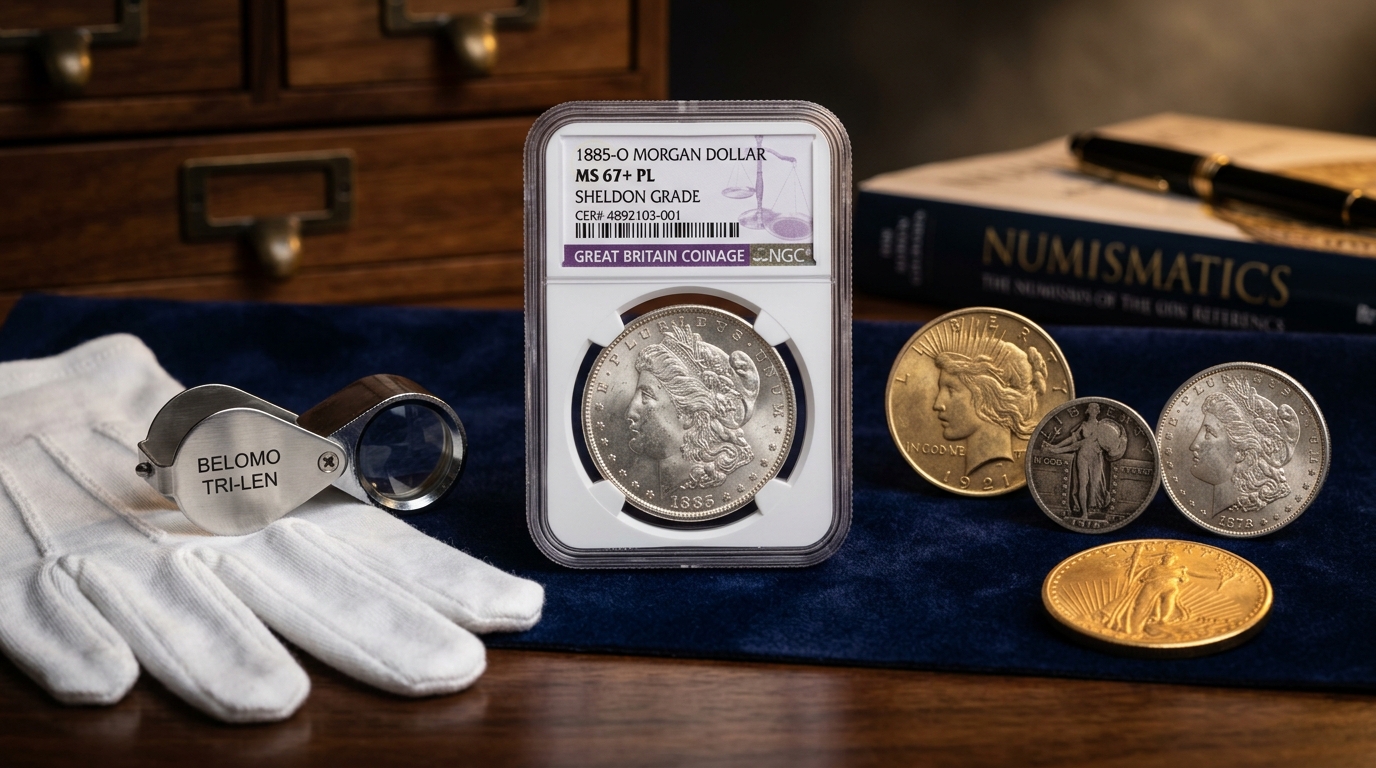
Third-party grading services (such as PCGS and NGC) provide standardized grading, authentication, and tamper-evident sonic sealing: - Certified coins consistently realize higher auction prices because buyers are guaranteed authenticity, , and surface preservation. - Certification eliminates subjective disputes between buyers and sellers regarding attribution.
Essential Collector Tips for High-Value Coins
When collecting or investing in valuable Indian coins, following best practices protects your capital and ensures the long-term enjoyment of your collection:
- 1. Research Thoroughly Before Purchasing: Study the historical context, mintage figures, differences, and past auction records for the specific coin type.
- 2. Study Genuine Dies & Surface Characteristics: Train your eye by examining authenticated specimens in museum collections, official catalogues, and certified slabs to recognize genuine engraving and natural metal aging.
- 3. Buy from Reputable Dealers & Auction Houses: Work with established, accredited numismatic dealers and recognized auction houses that offer unconditional authenticity guarantees.
- 4. Never Clean or Alter a Coin: , wiping, polishing, or chemically treating a historic coin strips its original luster and natural , destroying up to 80% to 90% of its numismatic value.
- 5. Store in Archival-Quality Holders: Use inert, PVC-free coin capsules, non-reactive flips, and climate-controlled storage boxes to protect coins from humidity, sulfur, and environmental oxidation.
- 6. Focus on Quality Over Quantity: A small collection of high-grade, verified key-date rarities will almost always outperform a large accumulation of common, low-grade coins.
- 7. Seek Professional Authentication for High-Value Acquisitions: For coins valued at ₹50,000 or above, insist on third-party certification or verified documentation.
Notable High-Value Indian Coins Reference Table
Here is a summary of some of the most notable high-value Indian coin types, their historical era, and indicative market value ranges:
| Coin Type | Historical Era / Dynasty | Typical Indicative Value Range* |
|---|---|---|
| Gupta Gold Dinar (Archer / Lion Slayer) | Gupta Empire (4th–6th Cent. CE) | ₹2,00,000 – ₹1,00,00,000+ |
| Samudragupta Veena / Ashvamedha Dinar | Gupta Empire (c. 335–375 CE) | ₹10,00,000 – ₹2,00,00,000+ |
| Gandhara / Magadha Bent Bar Shatamana | Ancient Janapadas (6th–4th Cent. BCE) | ₹25,000 – ₹10,00,000+ |
| Sher Shah Suri Silver Rupee (Rare Mint) | Suri Dynasty (1540–1545 CE) | ₹50,000 – ₹15,00,000 |
| Vijayanagara Gold Pagoda (Varaha) | Vijayanagara Empire (14th–16th Cent.) | ₹1,00,000 – ₹50,00,000+ |
| Akbar Gold Mohur (Square / Ilahi) | Mughal Empire (1556–1605 CE) | ₹10,00,000 – ₹5,00,00,000+ |
| Jahangir Zodiac Gold Mohur (Leo / Taurus) | Mughal Empire (1605–1627 CE) | ₹1,00,00,000 – ₹10,00,00,000+ |
| Shah Jahan Presentation Gold Mohur | Mughal Empire (1628–1658 CE) | ₹20,00,000 – ₹5,00,00,000+ |
| Shivaji Maharaj Gold Hon | Maratha Empire (1674–1680 CE) | ₹3,00,000 – ₹50,00,000+ |
| Shivaji Rajyabhishek Coronation Coin | Maratha Empire (1674 CE) | ₹25,00,000 – ₹1,00,00,000+ |
| Rare Princely State Gold Nazarana Mohur | Hyderabad / Jaipur / Kutch / Baroda | ₹5,00,000 – ₹1,00,00,000+ |
| British India 1835 William IV Pattern Rupee | British India (1835) | ₹20,00,000 – ₹2,00,00,000+ |
| British India 1911 George V "Pig Rupee" (MS) | British India (1911) | ₹50,000 – ₹10,00,000+ |
| British India 1939 Silver Rupee (.917 Silver) | British India (1939) | ₹5,00,000 – ₹50,00,000+ |
| Republic of India 1950 Proof Set (7 Coins) | Republic of India (1950) | ₹1,00,000 – ₹15,00,000 |
| Republic Dramatic Mule / Off-Center Error | Republic of India (1970–2024) | ₹20,000 – ₹5,00,000+ |
Note: Values are indicative auction and market ranges depending heavily on variety, rarity, provenance, certification, and surface grade.
Curated Specimen Examples
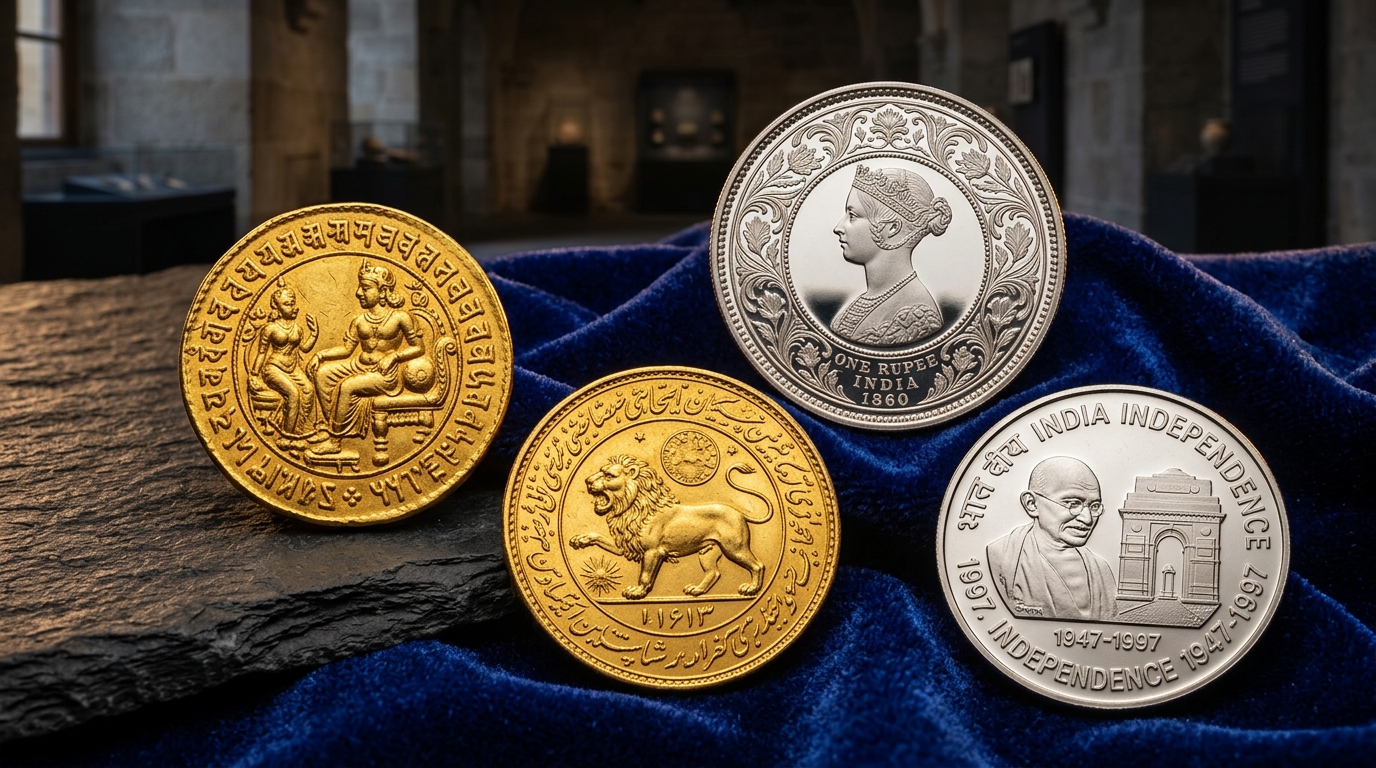
Struck during Jahangir’s reign (1605–1627 CE), depicting the twelve astrological zodiac constellations. Survived Shah Jahan’s mass melting order to become among the most valuable coins in world numismatics.
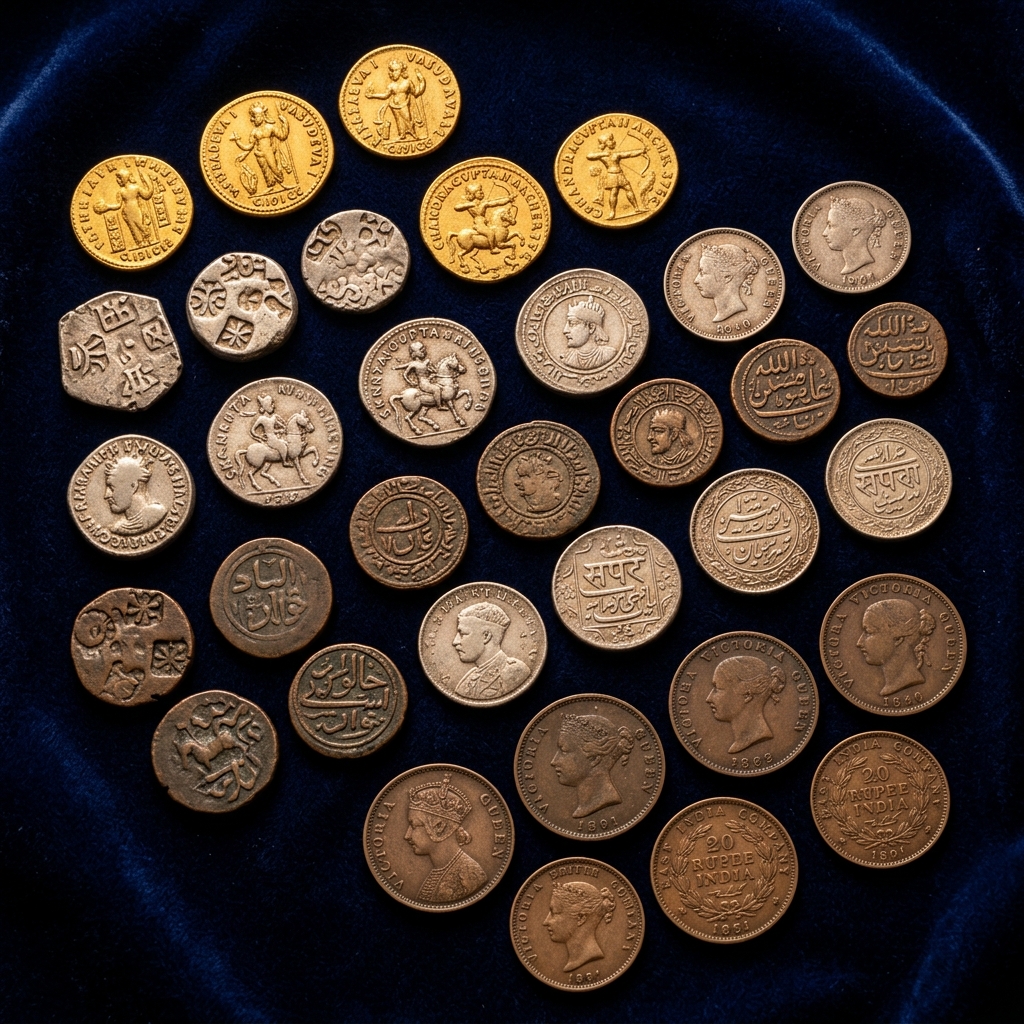
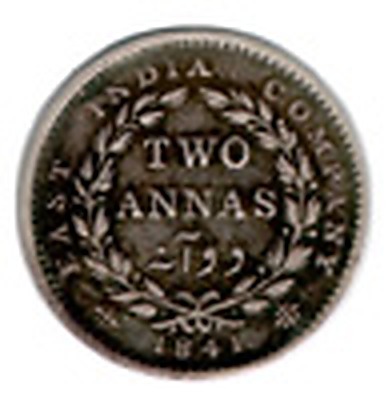
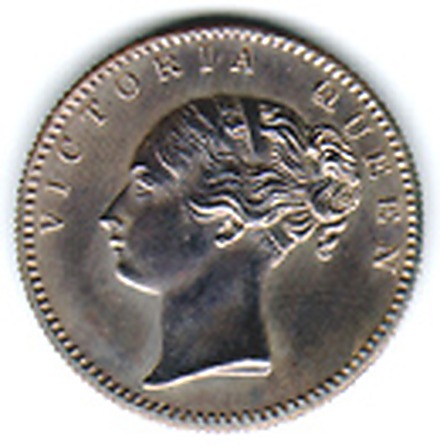
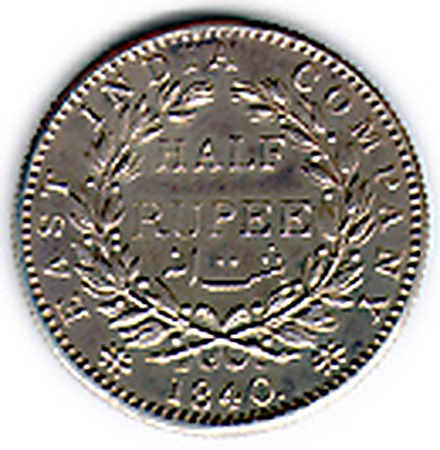
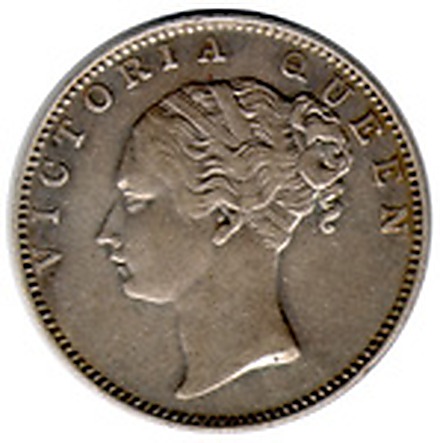
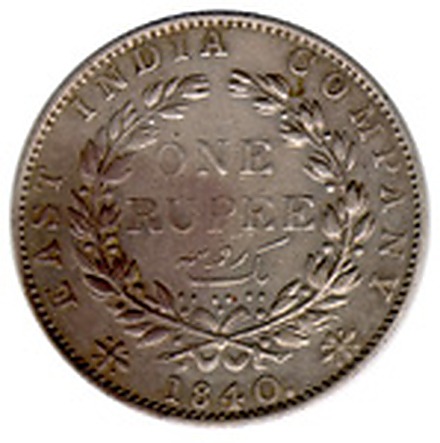
From 1835 William IV trial patterns and 1939 silver rupees to 1950 inaugural Republic proof sets and dramatic mule errors, modern and colonial rarities command intense collector competition.
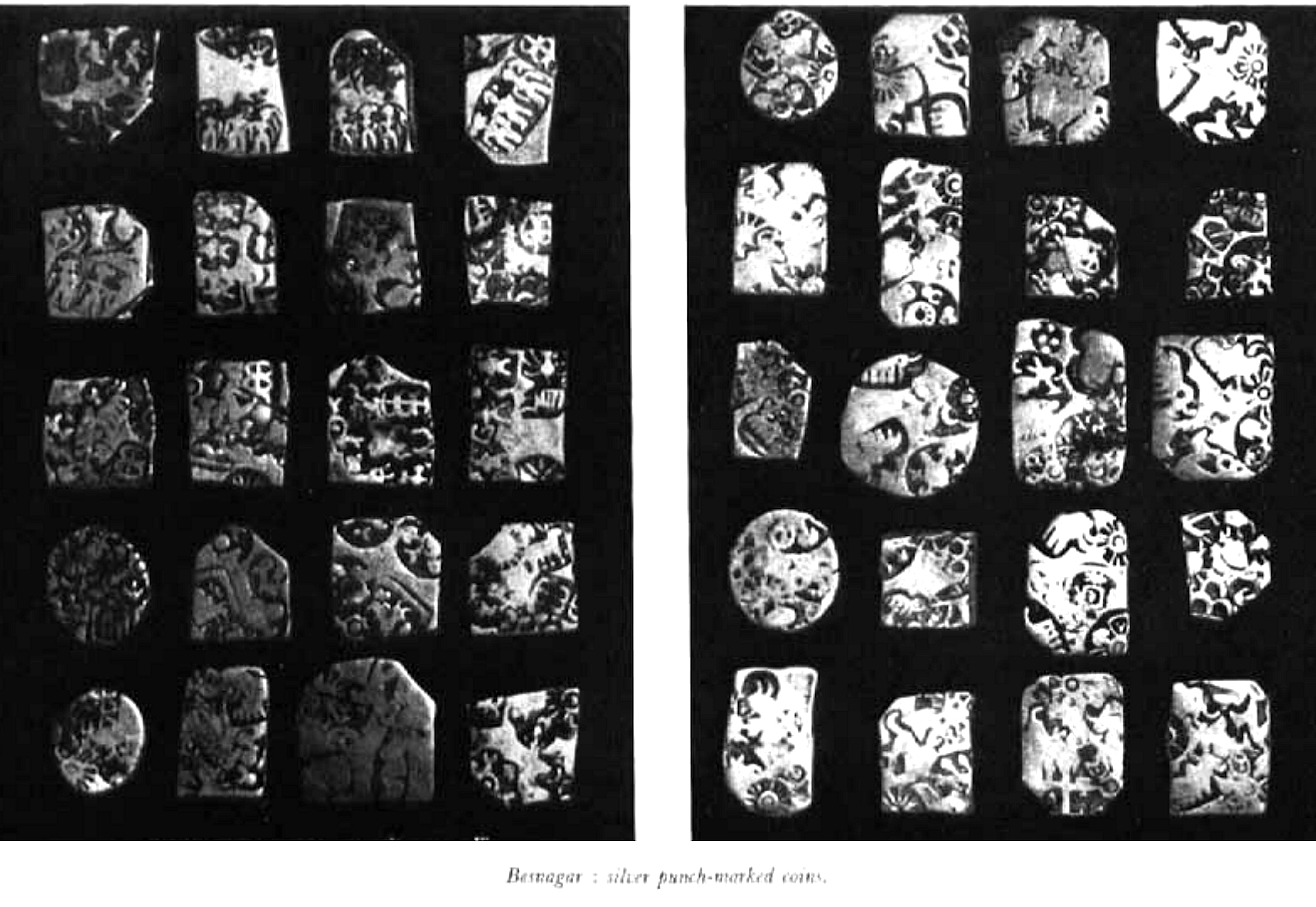
Among humanity’s earliest monetary issues, these long silver bent bars and punch-marked coins from Magadha and Kuru Janapadas represent the birth of Indian currency over 2,500 years ago.
The iconic first definitive one rupee coin of sovereign India featuring the Ashoka Lion Capital and ears of corn design, prized in Gem uncirculated and proof condition.
Common Pitfalls & Mistakes to Avoid
Frequently Asked Questions
Are old Indian coins always valuable?
No. Age alone does not determine value. Millions of ancient and medieval coins survive in large quantities, while some coins struck just 30 or 50 years ago are exceptionally valuable due to low mintages, uncirculated condition, or rare minting varieties and errors.
Are all gold Indian coins expensive?
Most historic gold coins have strong baseline value due to their precious metal content (bullion value), but their numismatic collector value varies dramatically depending on the issuing ruler, rarity, historical importance, and physical condition grade.
Which Indian coin has sold for the highest price?
Among Indian coins, Jahangir’s Zodiac Gold Mohurs and gigantic Mughal presentation coins hold the highest recorded auction records, with exceptional specimens achieving multiple crores of rupees (often several million US dollars) at major international numismatic auctions.
Should beginners collect expensive coins?
Not necessarily. Most numismatists recommend starting with affordable, well-documented series (such as common British India or Republic circulation coins), learning the nuances of grading, authentication, and mint marks before investing in high-value rarities.
How do I know if my coin is genuine or a reproduction?
Examine the coin’s weight, diameter, metal density, and edge reeding against official catalogue specifications. Look closely for cast bubbles, soft details, or incorrect die styles. For high-value coins, submission to professional third-party grading services (like PCGS or NGC) is strongly recommended.
Explore the details
Was this numismatic guide helpful?
Your feedback helps our curatorial editorial team refine and expand our research.